
| 일 | 월 | 화 | 수 | 목 | 금 | 토 |
|---|---|---|---|---|---|---|
| 1 | 2 | 3 | 4 | 5 | 6 | 7 |
| 8 | 9 | 10 | 11 | 12 | 13 | 14 |
| 15 | 16 | 17 | 18 | 19 | 20 | 21 |
| 22 | 23 | 24 | 25 | 26 | 27 | 28 |
- ODQA
- AI Math
- N2N
- pyTorch
- 딥러닝
- GPT
- Transformer
- Bert
- 현대자동차
- seaborn
- Self-attention
- Bart
- Attention
- 2023 현대차·기아 CTO AI 경진대회
- passage retrieval
- KLUE
- 데이터 시각화
- RNN
- nlp
- 기아
- Ai
- word2vec
- mrc
- N21
- 데이터 구축
- matplotlib
- dataset
- Optimization
- Data Viz
- AI 경진대회
- Today
- Total
쉬엄쉬엄블로그
(NLP) Intro to NLP 본문
이 색깔은 주석이라 무시하셔도 됩니다.
Intro to NLP
Goal of This Course
- Natural language processing (NLP), which aims at properly understanding and generating human languages, emerges as a crucial application of artificial intelligence, with the advancements of deep neural networks.
- 인간의 언어를 올바르게 이해하고 생성하는 것을 목표로 하는 자연어 처리(NLP)는 심층 신경망의 발전과 함께 인공지능의 중요한 응용 프로그램으로 부상하고 있다.
- This course will cover various deep learning approaches as well as their applications such as language modeling, machine translation, question answering, document classification, and dialog systems.
- 이 과정에서 언어 모델링, 기계 번역, 질문 답변, 문서 분류 및 대화 시스템과 같은 다양한 딥러닝 접근법을 다룰 예정이다.
Academic Disciplines related to NLP
Natural language processing (major conferences : ACL, EMNLP, NAACL)
- includes state-of-the-art deep learning-based models and tasks
- Low-level parsing
- Tokenization : 토큰화
- stemming : 형태소 분석, 어간 추출
- Word and phrase level
- Named entity recognition(NER)
- part-of-speech(POS) tagging
- 단어의 품사를 알아내는 작업
- noun-phrase chunking
- 구조화되지 않은 텍스트에서 구문을 추출하는 작업
- dependency parsing
- 문장에서 단어 사이의 의미적 관계를 식별하는 작업
- coreference resolution
- 임의의 개체(entity)를 표현하는 다양한 명사구(mention)들을 찾아 연결해주는 작업
- Sentence level
- Sentiment analysis
- 감성 분석
- machine translation
- 기계 번역
- Sentiment analysis
- Multi-sentence and paragraph level
- Entailment prediction
- 두 문장 간의 논리적인 모순 관계 예측
- question answering
- QA
- dialog systems
- 대화 시스템
- summarization
- 요약
- Entailment prediction
Text mining(major conferences : KDD, The WebConf (formelry, WWW), WSDM, CIKM, ICWSM)
- Extract useful information and insights from text and document data
- 텍스트 및 문서 데이터에서 유용한 정보와 인사이트를 추출
- e.g. analyzing the trends of AI-related keywords from massive news data
- e.g. 방대한 뉴스 데이터에서 AI 관련 키워드의 동향을 분석
- Documents clustering (e.g., topic modeling)
- 문서 군집화. (e.g. topic modeling)
- e.g. clustering news data and grouping into different subjects
- e.g. 뉴스 데이터를 군집화하고 다른 주제들로 그룹화함
- Highly related to computational social science
- 컴퓨터 사회 과학과 관련이 깊음
- e.g., analyzing the evolution of people’s political tendency based on social media data
- e.g. 소셜 미디어 데이터를 기반으로 사람들의 정치적 경향의 진화를 분석
Information retrieval (major conferences : SIGIR, WSDM, CIKM, RecSys)
- Highly related to computational social science
- This area is not actively studied now
- 이 분야는 현재 활발하게 연구되진 않음
- It has evolved into a recommendation system, which is still an active area of research
- 이 분야는 추천 시스템으로 진화하고 있고 추천 시스템이 지속적으로 연구되고 있음
- This area is not actively studied now
Trends of NLP
- Text data can basically be viewed as a sequence of words, and each word can be represented as a vector through a technique such as Word2Vec or GloVe.
- 텍스트 데이터는 기본적으로 단어의 시퀀스로 볼 수 있으며, 각 단어는 Word2Vec 또는 GloVe와 같은 기술을 통해 벡터로 나타낼 수 있음
- RNN-family models (LSTMs and GRUs), which take the sequence of these vectors of words as input, are the main architecture of NLP tasks.
- 이러한 단어의 벡터 시퀀스를 입력으로 취하는 RNN 모델군(LSTMs and GRUs)은 NLP task의 주요 구조임
- Overall performance of NLP tasks has been improved since attention modules and Transformer models, which replaced RNNs with self-attention, have been introduced a few years ago.
- 몇 년 전 self-attention으로 RNN을 대체한 attention 모듈과 트랜스포머 모델이 도입된 후 NLP task의 전반적인 성능이 향상됨
- As is the case for Transformer models, most of the advanced NLP models have been originally developed for improving machine translation tasks.
- 트랜스포머 모델의 경우와 마찬가지로 대부분의 advanced NLP 모델은 기계 번역 성능을 개선시키기 위해 개발됨
- In the early days, customized models for different NLP tasks had developed separately.
- 초기에는 서로 다른 NLP 작업에 대한 맞춤형 모델이 별도로 개발됨
- Since Transformer was introduced, huge models were released by stacking its basic module, self-attention, and these models are trained with large-sized datasets through language modeling tasks, one of the self-supervised training setting that does not require additional labels for a particular task.
- 트랜스포머가 도입된 이후 기본 모듈인 self-attention을 쌓아 거대한 모델이 출시되었으며, 이러한 모델은 특정 작업에 추가 label이 필요하지 않은 self-suprevised 학습 환경 중 하나인 언어 모델링 task를 통해 대규모 데이터로 학습됨
- e.g., BERT, GPT-3 …
- Afterwards, above models were applied to other tasks through transfer learning, and they outperformed all other customized models in each task.
- 이후 transfer learning을 통해 위의 모델들을 다른 task에 적용했고, 각 task에서 다른 모든 맞춤형 모델들을 능가함
- Currently, these models has now become essential part in numerous NLP tasks, so NLP research become difficult with limited GPU resources, since they are too large to train.
- 현재 이러한 모델들은 수많은 NLP task에서 필수적인 부분이 되었고 학습하기에는 너무 크기 때문에 제한된 GPU 자원으로 NLP 연구는 어려워짐
Bag-of-Words
Bag-of-Words Representation
- Step 1. Constructing the vocabulary containing unique words
- Step 1. 고유 단어가 포함된 어휘 사전 구성
- Example sentences : “John really really loves this movie”, “Jane really likes this song”
- Vocabulary : {”John”, “really”, “loves”, “this”, “movie”, “Jane”, “likes”, “song”}
- Step 2. Encoding unique words to one-hot vectors
- Step 2. 고유 단어를 one-hot 벡터로 인코딩
- Vocabulary : {”John”, “really”, “loves”, “this”, “movie”, “Jane”, “likes”, “song”}
- John : [1 0 0 0 0 0 0 0]
- really : [0 1 0 0 0 0 0 0]
- loves : [0 0 1 0 0 0 0 0]
- this : [0 0 0 1 0 0 0 0]
- movie : [0 0 0 0 1 0 0 0 ]
- Jane : [0 0 0 0 0 1 0 0]
- likes : [0 0 0 0 0 0 1 0]
- song : [0 0 0 0 0 0 0 1]
- For any pair of words, the distance is $\sqrt2$
- For any pair of words, cosine similarity is 0
- 단어의 의미에 상관없이 모두가 동일한 관계를 가지는 형태로 단어의 벡터 표현형을 설정
- A sentence/document can be represented as the sum of one-hot vectors
- 문장/문서는 one-hot 벡터의 합으로 표현될 수 있다.
- Sentence 1 : “John really really loves this movie”
- John + really + really + loves + this + movie : [1 2 1 1 1 0 0 0]
- Sentence 2 : “Jane really likes this song”
- Jane + really + likes + this + song : [0 1 0 1 0 1 1 1]
NaiveBayes Classifier for Document Classification
Bag-of-Words for Document Classification
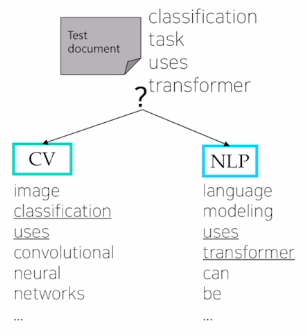
Bayes’ Rule Applied to Documents and Classes
For a document d and a class c
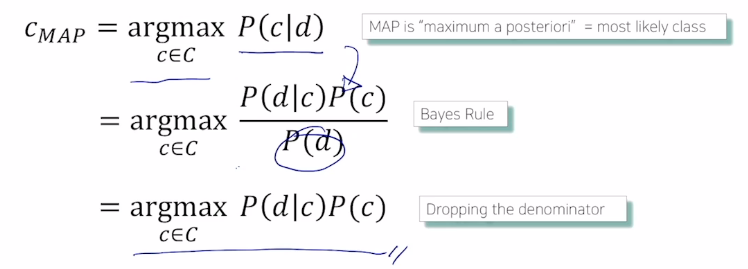
For a document d, which consists of a sequence of words w, and a class c
The probability of a document can be represented by multiplying the probability of each word appearing
- 문서의 확률은 각 단어가 나타날 확률을 곱하여 나타낼 수 있다.
$P(d|c)P(c)=P(w_1,w_2,...,w_n|c)P(c)\rightarrow P(c)\prod_{w_i\in W}P(w_i|c)$
(by conditional independence assumption)
Example
For a document d, which consists of sequence of words w, and a class c
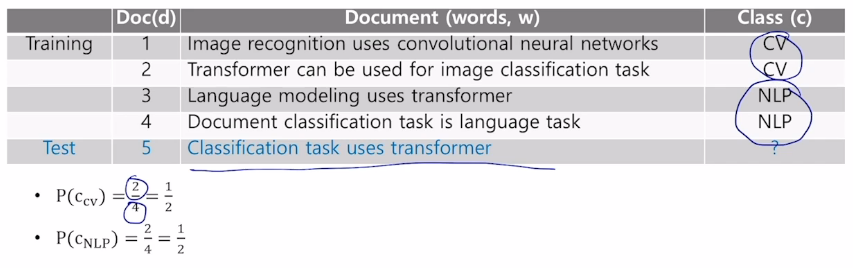
For each word $w_i$, we can calculate conditional probability for class c
$P(w_k|c_i)=\frac{n_k}{n'}$, where $n_k$ is occurrences of $w_k$ in documents of topic $c_i$
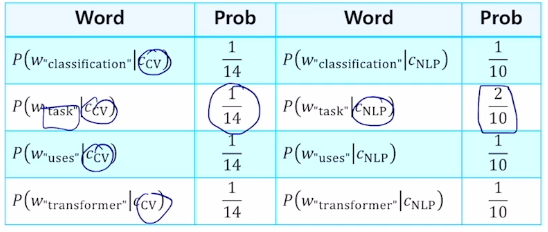
For a test document $d_5$ = “Classification task uses transformer”
- We calculate the conditional probability of the document for each class
- 각 클래스에 대한 문서의 조건부 확률을 계산한다.
- We can choose a class that has the highest probability for the document
- 문서에 대한 확률이 가장 높은 클래스를 선택할 수 있다.
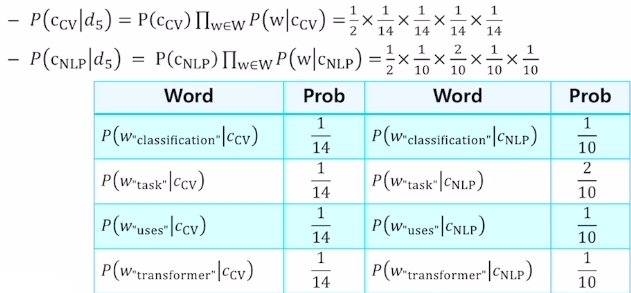
- We calculate the conditional probability of the document for each class
출처: 부스트캠프 AI Tech 4기(NAVER Connect Foundation)
'부스트캠프 AI Tech 4기' 카테고리의 다른 글
| (NLP) Basics of Recurrent Neural Network (0) | 2023.06.20 |
|---|---|
| (NLP) Word Embedding (0) | 2023.06.19 |
| (Data Viz) More Tips (+ 실습) (2) | 2023.06.16 |
| (Data Viz) Facet (+ 실습) (0) | 2023.06.15 |
| (Data Viz) Color (+ 실습) (0) | 2023.06.14 |


